

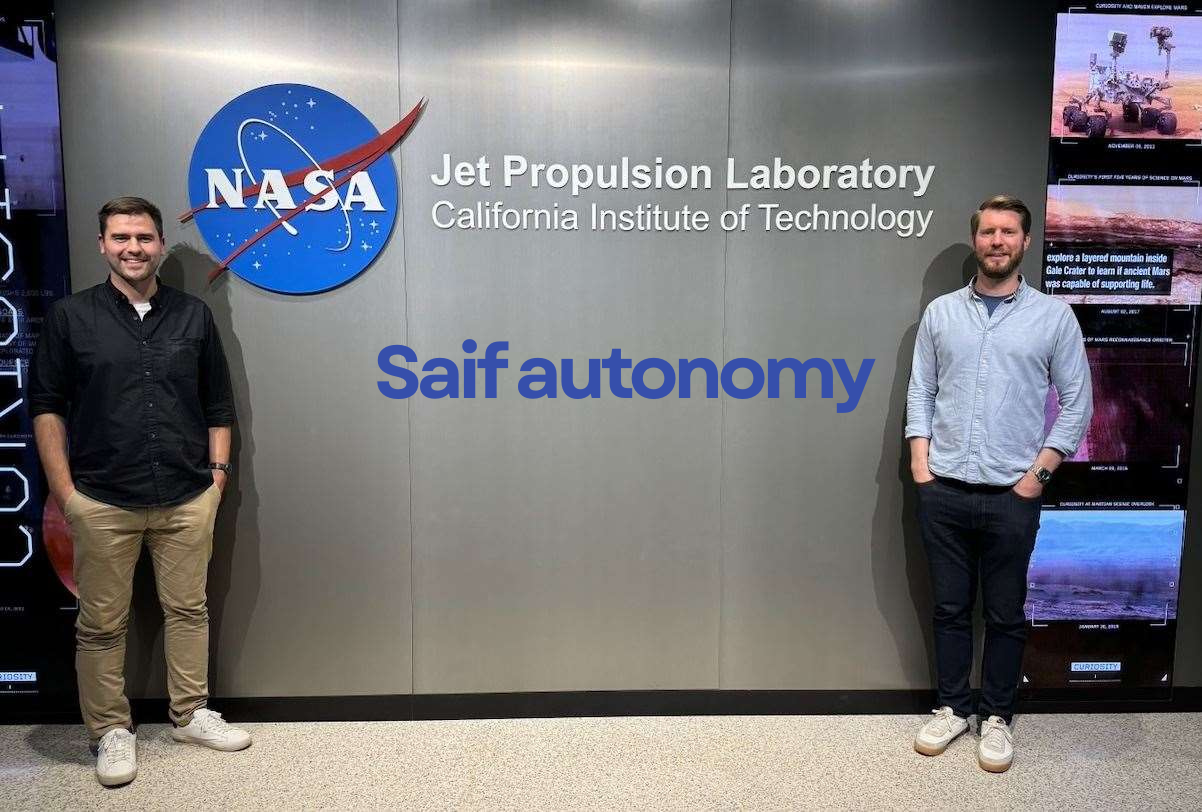
SAIF Autonomy is working on a problem that becomes harder as autonomous machines become more capable: how do you make sure an AI system stays within safe limits when it is making decisions on its own? That question is becoming especially relevant in defence, robotics and space, where a failure can have consequences that are difficult or impossible to correct remotely.
The UK company is developing runtime assurance technology intended to monitor autonomous systems while they operate. Its recent work has included the UK Ministry of Defence’s Software Defined Swarms programme and space-related autonomy projects. In July 2026, the company also presented its work at Farnborough International Airshow, including its involvement in rendezvous and proximity operations with the European Space Agency.
What SAIF Autonomy actually does
It is easy to confuse AI capability with AI assurance. They are not the same thing.
An autonomous vehicle, drone or spacecraft may use machine learning to decide what to do next. Assurance software sits alongside that decision-making process and checks whether the resulting behaviour remains inside predefined safety boundaries. In simple terms, the AI can make decisions, but another layer can intervene when those decisions conflict with rules or limits.
SAIF Autonomy’s main technology is called NEXUS. The company describes it as a runtime assurance platform that monitors autonomous behaviour at the edge and can prevent unsafe actions according to defined constraints. This approach is intended for systems that may use either traditional control methods or AI-based decision-making.
That distinction matters in safety-critical environments. A company does not necessarily need to replace its existing autonomy stack to add an assurance layer. Instead, the potential value of a system such as NEXUS is in providing an additional mechanism for controlling what an autonomous platform is allowed to do.
Why runtime assurance is different from ordinary AI testing
Testing an AI system before deployment is essential, but testing alone cannot cover every situation a machine might encounter in the real world.
Consider an autonomous drone operating in changing weather or a vehicle navigating an environment that differs from its training data. Engineers can test thousands of scenarios, but there will always be situations that are difficult to reproduce beforehand. Runtime assurance addresses a different part of the problem by monitoring the system while it is actually operating.
This does not mean the assurance layer makes an autonomous system automatically safe. Its effectiveness depends on how the safety rules are designed, what the system can observe, how quickly it can intervene and how the underlying hardware responds. Those details are critical when evaluating any runtime assurance technology.
For that reason, the more useful question is not simply whether a company claims to make AI “safe.” The practical question is what constraints can be specified, how violations are detected and what happens after an intervention.
SAIF Autonomy’s role in UK drone swarm research
One of the company’s most relevant 2026 activities is its participation in the first phase of the UK Ministry of Defence and Defence Science and Technology Laboratory Software Defined Swarms programme.
Applied Intuition UK leads the consortium, which also includes SAIF Autonomy, Rowden Technologies, Frazer-Nash Consultancy, Lancaster University and Evolve Dynamics. The programme is focused on developing and testing software-defined approaches to coordinated drone swarms. Janes reported that Evolve Dynamics’ Wolfe-NATO UAV was selected as the consortium’s main aircraft.
Swarming creates an interesting assurance problem because the complexity grows when several autonomous systems interact. It is one thing to define safe behaviour for a single drone. It is another to consider what happens when multiple machines share information, change their behaviour in response to one another and operate under changing mission conditions.
SAIF’s involvement therefore provides a useful real-world setting for its assurance technology. It also gives readers a clearer picture of where runtime assurance could matter: not as a replacement for autonomy, but as part of the control and safety architecture around it.
Space presents an even tougher test
Space is another area where autonomous decision-making can be valuable because communication delays, limited bandwidth and operational constraints can make constant human control impractical.
SAIF Autonomy has highlighted work involving Rendezvous Proximity Operations and Docking, commonly shortened to RPOD. In 2026, the company said it was supporting work connected with the European Space Agency and planned to showcase its technology at Farnborough International Airshow.
Autonomous rendezvous requires a spacecraft to manage relative position and movement carefully while approaching another object. Small errors can become serious problems, particularly during close-proximity operations.
The important point is that assurance is not the same as autonomous navigation. A navigation or control system determines how a spacecraft should move. An assurance layer can provide additional constraints around that behaviour. Keeping those roles separate can make the overall architecture easier to reason about and test.
The company has attracted early investment
SAIF Autonomy was founded in 2023 and was originally incorporated as SAIF Systems Ltd. Public company information identifies Kyle Thomas and Matthew Harris as its co-founders. The company later changed its name to SAIF Autonomy Ltd.
In February 2025, Cambridge Future Tech announced that SAIF Autonomy had raised $1.2 million in pre-seed funding led by Palo Alto-based Fusion Fund. Another investor database reports the round as £950,000, so the safest way to describe it is to use the figure provided by the company’s funding announcement and identify the source clearly when publishing.
The funding was intended to support product development, team growth and expansion into the US market. That is significant for a young deep-tech company because safety assurance is likely to require close technical collaboration with system manufacturers and operators rather than a simple consumer-style software rollout.
What to watch next
The interesting question for SAIF Autonomy is no longer simply whether autonomous systems will need safeguards. The industry is already moving toward greater autonomy. The harder question is how assurance technologies will be validated, integrated and accepted by customers and regulators.
For potential users, several details are worth watching. How is NEXUS integrated with existing autonomy software? What types of constraints can engineers formally define? How quickly can it intervene? What evidence is available from deployments and testing? And how does the system fit into the certification process for a safety-critical product?
Those questions are more useful than broad claims about making AI trustworthy. They turn an abstract promise into something engineers, regulators and customers can actually evaluate.
Conclusion
SAIF Autonomy represents a growing shift in the AI industry: from building more capable autonomous systems to ensuring those systems can be trusted in real-world, high-stakes environments. Its focus on runtime assurance places it in a critical but often overlooked layer of the autonomy stack—one that does not replace AI decision-making, but governs it in real time.
As autonomy expands into defence, space, and other safety-critical domains, the success of companies like SAIF will depend less on theoretical capability and more on demonstrable reliability, integration with existing systems, and acceptance by regulators and operators. If runtime assurance proves effective at scale, it could become a foundational component of how autonomous systems are safely deployed in the years ahead.
FAQs
Q: What is SAIF Autonomy?
A: SAIF Autonomy develops assurance technology for autonomous systems and physical AI.
Q: What is NEXUS by SAIF Autonomy?
A: NEXUS is a runtime assurance system designed to monitor and constrain autonomous behaviour.
Q: Does SAIF Autonomy work in defence?
A: Yes, SAIF Autonomy participates in the UK Software Defined Swarms programme.
Q: Does SAIF Autonomy work with space technology?
A: Yes, the company works on autonomy for space rendezvous and proximity operations.
Q: Why is SAIF Autonomy important?
A: Its technology aims to make autonomous systems safer, more controlled, and easier to trust.
