

Introduction
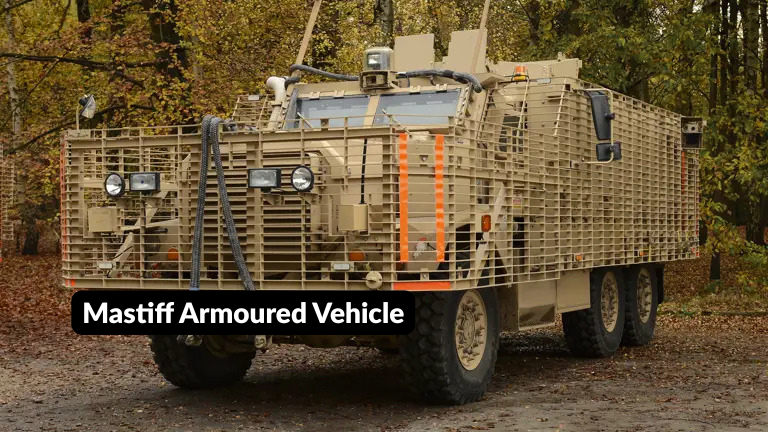
The Mastiff armoured vehicle is one of the most respected Mine-Resistant Ambush Protected (MRAP) vehicles used by the British Armed Forces. Designed to transport troops safely through hostile environments, it offers exceptional protection against landmines, improvised explosive devices (IEDs), and small-arms fire. Since entering service in the late 2000s, the Mastiff has played a significant role in military operations, particularly in Iraq and Afghanistan, where roadside bombs became one of the greatest threats to soldiers.
Unlike conventional armored personnel carriers, the Mastiff Armoured Vehicle was engineered with crew survivability as its highest priority. Its reinforced V-shaped hull, advanced armor systems, and powerful drivetrain allow it to operate in dangerous environments while minimizing the impact of explosions beneath the vehicle. These capabilities quickly made it a trusted platform among British troops and military planners.
Today, the Mastiff remains an important asset within the British Army’s protected mobility fleet. Although newer armored vehicles continue to enter service, the Mastiff is still valued for its proven battlefield performance, reliability, and ability to protect personnel during patrols, convoy escorts, peacekeeping missions, and training exercises.
What Is the Mastiff Armoured Vehicle?
The Mastiff armoured vehicle is a heavily protected military patrol and troop transport vehicle developed to provide outstanding protection against mines and ambushes. It is based on the American Cougar 6×6 MRAP platform but incorporates numerous modifications to meet British operational requirements.
The vehicle’s primary mission is transporting soldiers safely through high-risk areas where explosive devices and ambushes are common. It also supports convoy protection, reconnaissance, route security, and peacekeeping operations.
Its combination of heavy armor, off-road capability, and spacious interior makes it suitable for transporting troops, equipment, and supplies across difficult terrain.
History and Development
During military campaigns in Iraq and Afghanistan, coalition forces faced an increasing number of roadside bomb attacks. Traditional armored vehicles often lacked sufficient protection against these powerful explosive devices, leading to the demand for specialized mine-resistant vehicles.
To meet this requirement, the British Ministry of Defence selected the Cougar MRAP platform developed in the United States. The vehicle was adapted with British communications equipment, electronic systems, additional armor, and mission-specific modifications before entering service as the Mastiff.
Once deployed, the Mastiff quickly demonstrated its ability to withstand blasts that might otherwise have caused severe casualties. Numerous incidents during operations showed crews surviving explosions thanks to the vehicle’s advanced protective design.
Purpose and Military Role
The Mastiff Armoured Vehicle was developed to improve troop safety while maintaining operational mobility.
Its primary roles include:
- Protected troop transport
- Military patrol operations
- Convoy escort
- Route clearance support
- Peacekeeping missions
- Urban security operations
- Rapid deployment of personnel
- High-risk logistics support
Because of its exceptional blast protection, the Mastiff is especially valuable in regions where improvised explosive devices present a constant danger.
Design and Construction
One of the defining characteristics of the Mastiff is its rugged construction.
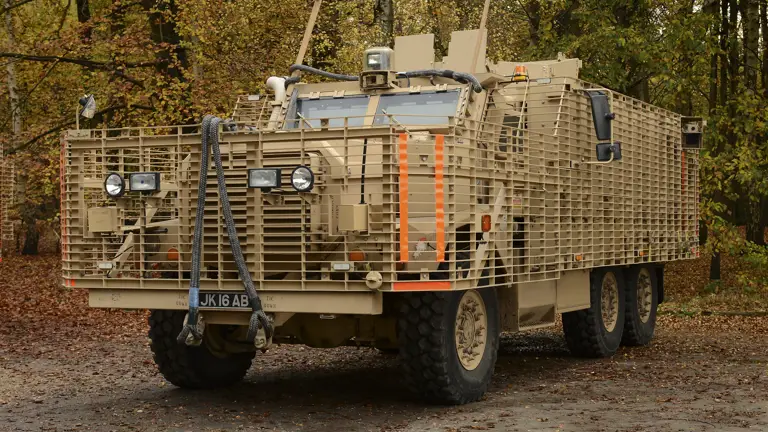
The vehicle is built using a reinforced steel frame combined with advanced composite armor. Its elevated chassis increases the distance between the ground and the crew compartment, helping reduce the impact of landmine explosions.
The spacious interior accommodates a driver, commander, and a squad of fully equipped soldiers while allowing room for communications equipment and mission supplies.
Large armored windows provide excellent visibility, while reinforced blast-resistant doors enhance crew safety during combat operations.
Technical Specifications
| Specification | Details |
|---|---|
| Vehicle Type | Mine-Resistant Ambush Protected (MRAP) |
| Base Platform | Cougar 6×6 |
| Country of Service | United Kingdom |
| Crew | 2 |
| Troop Capacity | Up to 8 soldiers |
| Drive Configuration | 6×6 |
| Engine | Caterpillar C7 Turbo Diesel |
| Transmission | Automatic |
| Maximum Speed | About 55 mph (89 km/h) |
| Operational Range | Around 600 km (373 miles) |
| Weight | Approximately 23–24 tonnes |
| Primary Mission | Protected troop transport |
Engine and Performance
The Mastiff Armoured Vehicle is powered by a Caterpillar turbocharged diesel engine capable of moving the heavily armored vehicle across difficult terrain.
Its automatic transmission and six-wheel-drive system provide reliable mobility on roads, gravel, mud, sand, and rocky surfaces. Although its heavy armor limits maximum speed compared with lighter military vehicles, the Mastiff offers dependable performance during long patrols and convoy operations.
Its advanced suspension also improves ride quality, reducing fatigue for soldiers during extended missions.
Armor and Protection
Protection is the Mastiff’s greatest strength.
Its V-shaped hull redirects blast energy away from the crew compartment during mine or IED explosions. Combined with reinforced armor plating, this design significantly increases occupant survivability.
The vehicle provides protection against:
- Landmines
- Roadside bombs (IEDs)
- Small-arms fire
- Artillery fragments
- Grenade shrapnel
Inside the cabin, blast-attenuating seats reduce the force transferred to passengers during explosions, while automatic fire suppression systems provide additional protection.
Weapons and Armament
Although primarily designed as a protected transport vehicle, the Mastiff can carry various defensive weapons depending on operational requirements.
Common weapon options include:
- 7.62 mm General Purpose Machine Gun
- 12.7 mm Heavy Machine Gun
- 40 mm Automatic Grenade Launcher
Some variants are equipped with remote weapon stations, allowing operators to engage targets without exposing themselves to enemy fire.
Crew and Passenger Capacity
The vehicle is normally operated by:
- Driver
- Vehicle Commander
In addition, it can transport approximately eight fully equipped soldiers, depending on mission configuration.
Its spacious interior allows troops to travel with weapons, protective equipment, communication devices, and mission supplies while maintaining a high level of comfort and safety.
Off-Road Capability
The Mastiff is designed to operate in harsh environments.
Its high ground clearance, durable suspension, and six-wheel-drive system allow it to travel across rough terrain where standard military trucks would struggle.
It performs effectively on:
- Desert roads
- Rocky terrain
- Mud
- Gravel
- Rural tracks
- Urban streets damaged by conflict
This versatility makes it suitable for a wide range of military operations.
Variants
Several variants have been developed to meet different operational needs.
Mastiff 1
The original version introduced enhanced blast protection for operations in Iraq.
Mastiff 2
An upgraded model featuring improved armor, suspension, and communications equipment.
Mastiff 3
The latest operational version includes further protection improvements and enhanced mobility for modern military missions.
Operational History
The Mastiff Armoured Vehicle became widely known during British operations in Iraq and Afghanistan.
Its ability to survive powerful explosions saved numerous lives and significantly reduced casualties compared with earlier protected vehicles.
The vehicle proved especially effective during:
- Convoy escort missions
- Urban patrols
- Supply transport
- Counter-insurgency operations
- Peacekeeping deployments
Its operational success established it as one of the most effective MRAP vehicles in British service.
Advantages
The Mastiff offers numerous operational benefits.
Its exceptional mine protection is regarded as one of its greatest strengths.
The spacious interior improves troop comfort during long deployments.
Its reliable diesel engine provides dependable performance under demanding conditions.
Advanced armor systems significantly improve crew survivability during attacks.
Excellent off-road capability allows the vehicle to operate in challenging environments.
Limitations
Despite its strengths, the Mastiff has some limitations.
Its heavy weight reduces agility compared with lighter armored vehicles.
The vehicle is also larger than many patrol vehicles, making movement through narrow urban streets more difficult.
Maintenance requirements are higher due to its specialized protective systems and heavy-duty components.
Latest 2026 Update
As of 2026, the Mastiff Armoured Vehicle remains in British Army service for protected mobility roles, training exercises, and selected operational deployments. While newer platforms such as the Boxer and Ajax are expanding the Army’s capabilities, the Mastiff continues to provide reliable blast protection and troop transport where its proven design remains valuable.
Conclusion
The Mastiff armoured vehicle represents one of the most successful MRAP platforms adopted by the British Army. Its exceptional protection against mines and improvised explosive devices has saved countless lives while providing soldiers with a dependable means of transportation in dangerous environments.
Although military technology continues to evolve, the Mastiff Armoured Vehicle remains an important example of how vehicle design can adapt to changing battlefield threats. Its robust construction, powerful protection systems, reliable mobility, and long operational history have secured its place among the world’s most respected protected military vehicles. Whether supporting peacekeeping operations, convoy escorts, or training missions, the Mastiff continues to demonstrate why it has earned the trust of military personnel for nearly two decades.
