

Introduction
Colaton Raleigh Devon is a small historic village in East Devon, situated in the lower Otter Valley in the south-west of England. Although it is not one of Devon’s best-known tourist destinations, the village has an unusually rich history, attractive traditional buildings and a close relationship with the River Otter and the East Devon Pebblebed Heaths.
The village offers a very different experience from busy coastal resorts and larger towns. Its character comes from old cottages, historic farmland, the parish church, local community facilities and the surrounding heathland. According to the Otter Vale Mission Community, the present village has a population of approximately 450 people and includes a general store, pub and village hall.
For anyone researching the area for travel, family history, local heritage or a possible visit, there is considerably more to discover than its quiet appearance might initially suggest.
Location
Colaton Raleigh is located in East Devon, close to the River Otter and within easy reach of several well-known Devon destinations. Sidmouth is nearby, while East Budleigh, Newton Poppleford and Exmouth are also within the wider surrounding area.
Its position makes the village particularly interesting for visitors who want to combine rural exploration with trips to the Devon coast. The landscape around the lower Otter Valley changes from farmland and woodland to heathland and coastal scenery, creating plenty of opportunities for walking and sightseeing.
The village itself has a traditional linear form, with roads and lanes connecting homes, historic properties and community buildings. Its setting gives it a distinctly rural atmosphere despite being relatively close to larger settlements.
Bio Table
| Detail | Information |
|---|---|
| Place Name | Colaton Raleigh |
| Location | East Devon, Devon, England |
| Type | Village and civil parish |
| Population | Approximately 450 residents |
| Historic Roots | Medieval period and earlier |
| River | River Otter |
| Historic Church | St John the Baptist Church |
| Notable Connection | Raleigh family |
| Nearby Area | East Devon Pebblebed Heaths |
| Nearby Towns | Sidmouth, East Budleigh, Exmouth |
| Main Character | Rural, historic and community-focused |
| Best Known For | Heritage, countryside, traditional buildings and walking |
The Name
The history of the village name is fascinating. The Otter Valley Association explains that “Colaton” may have developed from an Old English expression meaning the farm or settlement of Ceola, while “Raleigh” was added after the manor became associated with the Raleigh family during the medieval period.
The spelling of the settlement has changed considerably over the centuries. Historical records contain variations including Colaton, Collaton and Colyton-Rawleigh. These changes were common in medieval and early modern records because spelling was not standardised in the way it is today.
The Raleigh connection is particularly important because the family became one of Devon’s notable historic families. This association gives the village a place within the wider story of medieval and Tudor Devon.
Medieval Roots
The settlement has very deep historical roots. The Otter Valley Association records that the manor was associated with the Raleigh family from the 13th century, after an inheritance connected the property with Sir Wymond de Raleghe. The family continued as occupiers or landowners for several centuries.
The village was also connected with religious institutions and medieval landholding. Historical accounts describe relationships with Exeter Cathedral, Dunkeswell Abbey and other ecclesiastical interests.
This combination of manor, church and agricultural land shaped the development of the settlement. Many English villages grew around precisely these relationships, and the surviving buildings and landscape can still provide clues about that earlier way of life.
Place Court
One of the most intriguing historic properties in Colaton Raleigh Devon is Place Court, a property with medieval associations and architectural remains that help illustrate the village’s past.
The Otter Valley Association describes parts of the property as dating from the medieval period. Features reportedly surviving from the earlier building include elements of the porch, hall screen and a small oratory above the porch. The property was historically associated with the Deanery and later had several different uses before becoming privately owned.
There is also a longstanding local tradition connecting the property with Sir Walter Raleigh. The small oratory above the porch is traditionally said to be the place where Raleigh was baptised or christened. However, this should be treated as local tradition rather than an independently established biographical fact.
The property is not simply interesting because of its Raleigh connection. Its surviving medieval features, cob-and-thatch elements and relationship with Church Road make it an important part of the village’s architectural story.
St John the Baptist Church
The Church of St John the Baptist is arguably the most important historic landmark in the village. Historic England lists it as a Grade II* building, recognising its considerable architectural and historical significance. Parts of the church date from the late 12th or early 13th century, while its tower dates from the late 15th or early 16th century.
The church was substantially rebuilt in 1875 under architect R. M. Fulford. Despite the Victorian rebuilding, important medieval elements survived, including the transitional north arcade and the font. Historic England also records decorative sgraffito work associated with the rebuilding.
The church’s history extends even further back. Local historical research states that the building certainly existed before 1226 and was originally associated with both St John the Baptist and St Theobald.
For visitors interested in architecture, the combination of medieval survival and Victorian restoration makes the church especially worthwhile.
Traditional Buildings
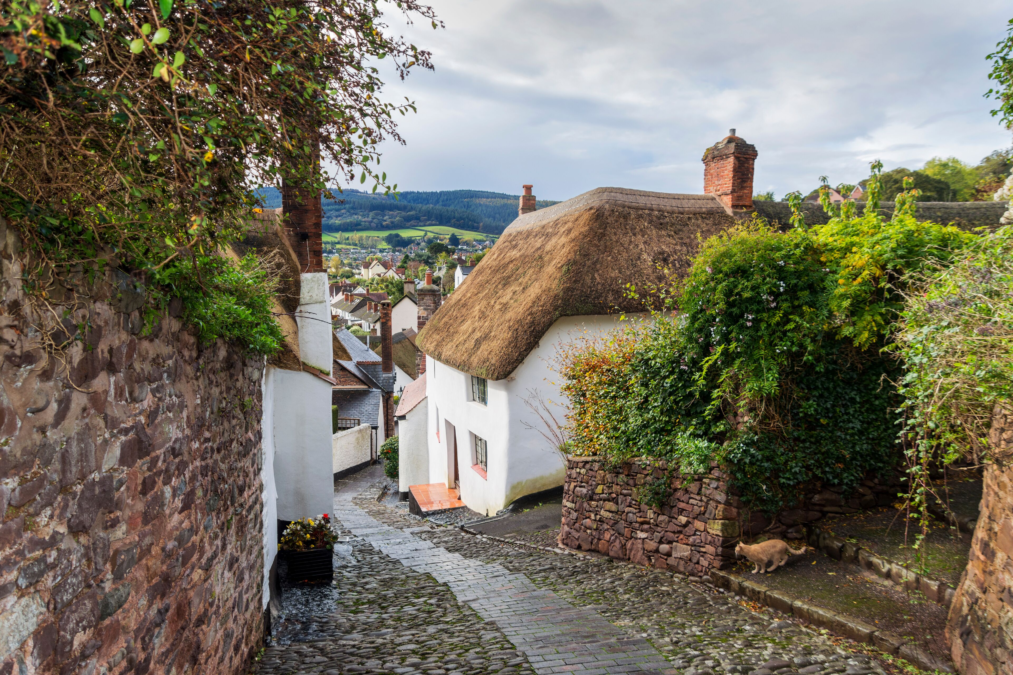
Another feature that gives Colaton Raleigh Devon its visual character is its collection of traditional houses and cottages. The village contains examples of cob construction, thatched roofs and older stone buildings.
Cob is a traditional West Country building material made largely from earth, clay and other natural materials. It was widely used in Devon because local soils provided suitable materials and it offered practical insulation.
The combination of cob walls, thatched roofs, narrow lanes and older farm buildings creates the appearance many people associate with traditional rural Devon. Some properties have been altered over the years, but the historic character remains visible.
Pebblebed Heaths
The countryside surrounding the village is one of its greatest attractions. Colaton Raleigh Common forms part of the wider East Devon Pebblebed Heaths, an important landscape of heathland, woodland and wetland habitats.
The Pebblebed Heaths organisation states that Colaton Raleigh Common covers approximately 333 hectares, making it the largest of the commons within the group. Its landscape includes dry heath, wet heath and mire, together with scattered pine trees, farmland and woodland around its boundaries.
The area is also significant for wildlife. The conservation organisation highlights species including the Southern Damselfly and Dartford Warbler, while archaeological features such as old quarries, barrows and historic boundary features add another layer of interest.
For walkers, photographers and nature enthusiasts, this landscape provides a strong reason to explore beyond the village centre.
Village Community
Despite its modest size, Colaton Raleigh Devon has maintained a genuine community atmosphere. The local church describes the settlement as having approximately 450 residents, alongside a general store, pub and village hall.
The village hall is particularly important because it provides a space for community activities and gatherings. In small rural settlements, facilities like these can play a much larger role than their size might suggest.
The local church also contributes to community life. Services, weddings, funerals and seasonal events help maintain connections between residents and families with long-standing links to the area.
River Otter Setting
The River Otter is another major part of the village’s identity. The parish occupies part of the lower Otter Valley, giving the surrounding countryside a mixture of riverside land, farmland and gently changing terrain.
The river has influenced settlement, agriculture and transport throughout the history of the valley. Today, its presence contributes to the area’s appeal for people interested in walking, wildlife and landscape photography.
The relationship between the village and river also explains why the area feels closely connected to the wider East Devon landscape rather than functioning as an isolated settlement.
Life and Travel
Living in Colaton Raleigh Devon can appeal to people who prefer a quieter environment and value countryside, heritage and community life. The village is small, however, so residents may need to travel to nearby towns for a wider selection of shops, schools, healthcare services and other facilities.
For visitors, this smaller scale can actually be part of the attraction. Instead of arriving in a heavily commercialised tourist destination, visitors encounter a working rural community with historic buildings and surrounding countryside.
Its location also makes it possible to combine a visit with nearby attractions in East Devon, including Sidmouth and the wider River Otter area.
Historical Population
The population of the settlement has changed considerably over time. Historical gazetteers recorded a much larger parish population in the 19th century because the historic parish covered a broader area and included several hamlets. A Victorian-era description recorded hundreds of residents and numerous houses across the parish.
Modern descriptions put the village population at roughly 450 people, illustrating how the character and scale of the settlement have changed over the generations.
These changes reflect wider patterns seen across rural England, where agricultural employment, transport, housing and migration have transformed village populations.
Age, Appearance and Net Worth
Because the subject here is a village rather than an individual person, details such as age, height, physical appearance, family and net worth do not apply. There is no single person called Colaton Raleigh whose biography could legitimately include those details.
Instead, the useful “profile” of the place concerns its age, heritage, population, architecture, landscape and community facilities. Its history stretches back at least to the medieval period, while some surviving church elements date to the late 12th or early 13th century.
There is also no meaningful personal social-media profile for the village itself. Information is instead available through local organisations, parish and church resources, heritage organisations and conservation groups.
Why Visit?
The appeal of Colaton Raleigh Devon lies in the way several different aspects of Devon’s heritage come together in one small area. Visitors can see a medieval church, traditional cob and thatched buildings, explore a historic village landscape and then head into extensive heathland.
It is particularly suitable for people who enjoy history, architecture, walking, wildlife and quieter rural destinations. The nearby Pebblebed Heaths add an ecological dimension, while the Raleigh association provides an interesting historical connection.
Rather than being a destination built around one major attraction, the village is best appreciated as a complete historic landscape.
Colaton Raleigh Devon is a small settlement with a surprisingly deep story. Its medieval connections, Raleigh family associations, historic church, traditional architecture and position beside the River Otter make it an interesting part of East Devon.
The village’s greatest strength is its authenticity. It has not lost its rural character, yet it offers enough history and natural beauty to reward visitors who take time to explore. From the Grade II* church and historic Place Court to Colaton Raleigh Common and the surrounding Otter Valley, the area provides a fascinating mixture of heritage and countryside.
For anyone looking beyond Devon’s famous beaches and tourist towns, this quiet village offers an opportunity to discover a more traditional side of the county—one shaped by centuries of farming, religion, local families, wildlife and community life.
